Thermowood Cladding: Profiles, Installation & Maintenance
A practical guide to thermowood cladding, covering timber species, profiles, installation, maintenance and choosing the right finish for your facade.
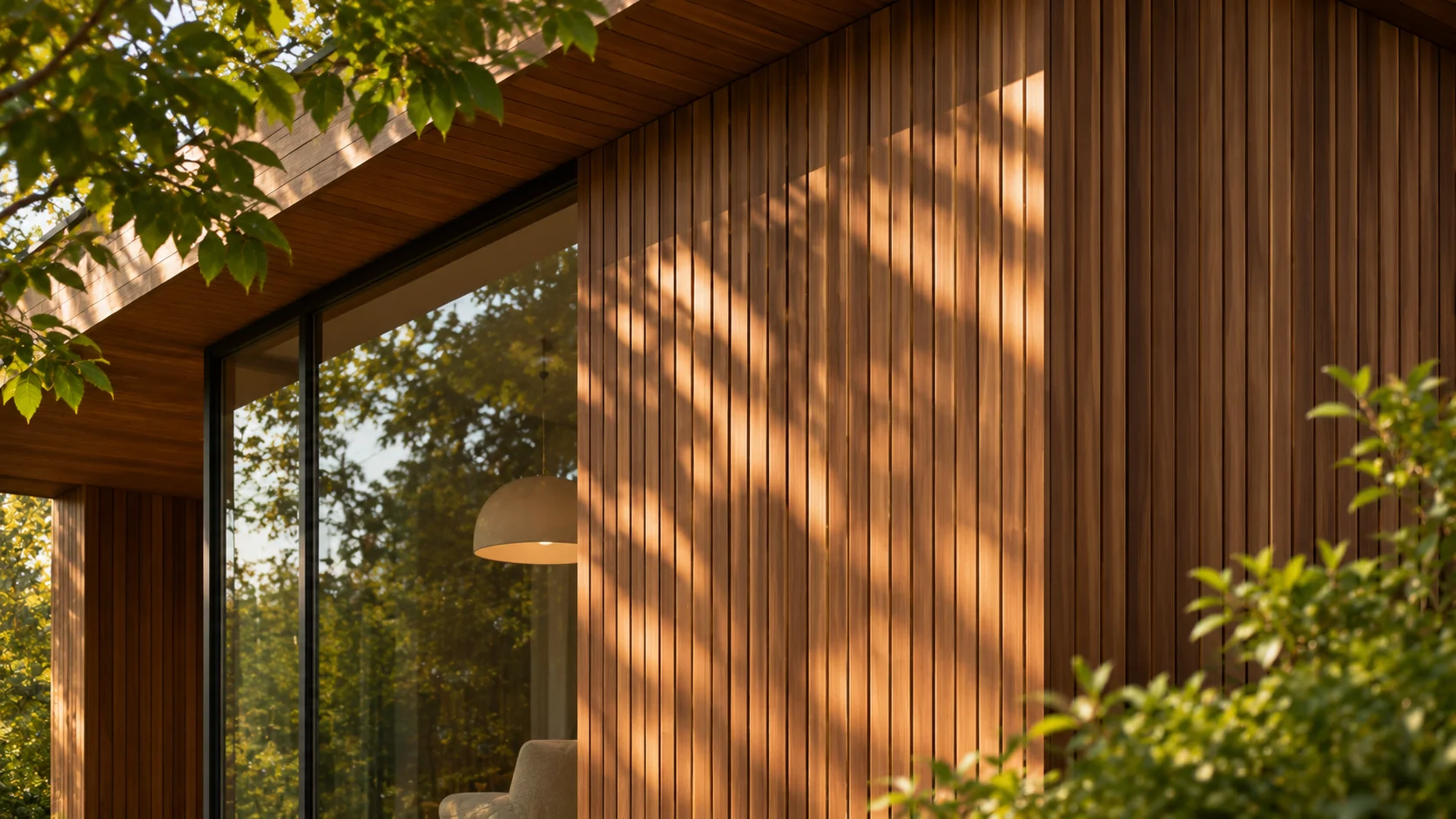
A facade provides a strong connection between architecture and its surroundings. Timber cladding provides a warm aesthetic for your facade as the natural grain of the timber soften the sharp architectural lines. Its effects also vary according to how the light impacts the timber and so carefully designing your facade using timber cladding can add a more tactile feel and an expressive element to your design.
At Lognest, we provide Thermowood cladding as part of our NordenTherm Collection. This consists of thermally modified timber for architectural uses including facades, wall cladding, decking and internal panelling. We offer various profiles within the range including Thermo Pine, Thermo Ash, Thermo Ayous and Thermo Birch. This guide covers Thermo wood cladding, the benefits, profiles available, installation requirements and maintenance of the timber solutions we offer.
What is thermowood cladding?
Thermowood cladding is a wall-facing system made from timber that has undergone controlled thermal modification. During this process, the wood is exposed to elevated temperatures under carefully managed conditions, typically using heat and steam with reduced oxygen. The result is thermally modified wood cladding, which is also often called heat-treated wood cladding.
Thermal modification changes aspects of the timber's physical and chemical structure. Thermal wood generally reduces moisture uptake and improves dimensional stability, while also improving resistance to certain forms of biological decay compared with the same untreated wood.
The process does not make timber waterproof or eliminate the need for maintenance. The material still needs suitable detailing, drainage, ventilation and protection from conditions outside its intended application.
At Lognest, our NordenTherm timber is processed at our dedicated thermal modification facility in Sweden, where we maintain control over the process and product quality. The collection brings together thermally modified species for projects where natural timber and considered architectural detailing are equally important.
Which profiles are available?
Profile | Visual character | Where it can work |
V-Groove | Repeated grooves create a clear linear rhythm | Facades and feature walls requiring a defined board pattern |
DUO | A paired or repeated surface rhythm, depending on the product design | Contemporary cladding schemes with a more structured appearance |
Dual Shadow | Pronounced shadow lines add depth and contrast | Architectural facades where light and shadow are part of the design |
Triplet | A repeated multi-line pattern creates a more articulated surface | Feature facades and selected interior panelling |
Strip | A linear surface expression with a strong emphasis on the board pattern | Cladding and panelling applications |
Rhombus | Angled board geometry creates a more pronounced architectural profile | Suitable outdoor structures and applications specified for the product |
How Is Thermowood Cladding Installed?
A timber facade works as part of a wall system. The Thermowood Cladding boards give the look but the frame behind them, the drainage, the airflow and the weather guard are just as important. The exact way to install Thermowood Cladding depends on the chosen Lognest profile, the base surface, the building design and the weather conditions.
Step 1: Assess the base surface and wall assembly. Before putting on thermowood cladding, check the walls' condition, how much water it might get and whether it is fit for thermowood cladding. The wall assembly must have proper weather protection and a way to move water that reaches the space behind the Thermowood cladding. Any water problem that already exists must be fixed before putting on thermowood cladding.
Step 2: Plan the support frame. Thermowood cladding is usually fastened to a support frame. The size and spacing of the battens depend on the Thermowood cladding board size, the chosen profile, the fixing needs and the project rules. For a ventilated rainscreen, the cavity behind the Thermowood cladding must be made to allow drainage and airflow. Its layout should always follow the project design and the product advice.
Step 3: Choose the board direction. Horizontal and vertical thermowood cladding give different looks. Horizontal boards can make the building look wider while vertical boards can draw the eye upwards. The chosen direction must also fit the support frame, the fixing details and the water control plan. Plan the Thermowood Cladding joints, corners, window gaps and changes before doing the work so that no improvisation is needed on site.
Step 4: Use fasteners. Pick fasteners that match the timber, the exposure conditions and the support frame. Fasteners that do not rust are essential for work, and the right material and grade must be checked for the project. Follow the product instructions for where to put the fasteners, how far from the edges and whether pre‑drilling is needed.
Step 5: Detail openings and exposed edges. Window frames, external corners, the bottom edge of thermowood cladding and changes in material need special care. The details should push water away from vulnerable surfaces while keeping the intended drainage and airflow paths. The ends of thermowood cladding boards and other exposed areas may also need treatment depending on the product and the exposure.
Step 6: Inspect the completed facade. Once the boards are installed, check their alignment, joint consistency, fixing quality and the continuity of the drainage and ventilation arrangements. A well-detailed facade should be designed not only to look finished on installation day but also to accommodate exposure and routine maintenance over time.
Step 6: Inspect the facade. After the Thermowood Cladding is installed, check the alignment, the consistency of the joints, the quality of the fasteners and the continuity of the drainage and airflow routes. A well‑finished thermowood cladding facade should not only look good on the day it is finished but should also handle weather and routine cleaning for many years.
Does it need oiling?
Generally it does’nt because the oiling requirement for Thermowood cladding rmainly depends on the desired appearance or the selected finish along with the conditions to which the facade is exposed. We often see how untreated, exposed Thermowood ends up changing colour under sunlight and harsh weather, gradually forming a silver-grey patina. This change however can occur at different rates across the building, mainly depending on factors such as the facade orientation, the shade it receives, rain exposure and also sheltered areas. For projects that prefer this natural weathering, an unfinished surface is the better choice.
If the intention however is to retain more of the original brown tone, then a suitable exterior coating with UV protection may help slow down the colour change, however it will not necessarily prevent all sorts of weathering, and the coating may still need periodic renewal. Always remember that before applying any finish, be sure to confirm its compatibility with the selected Thermowood product and make sure to test samples first if colour consistency is important to the design.
How does thermal wood cladding weather?
Timber generally tends to change when it faces or goes through harsh sunlight, heavy rainfall as well as variations in humidity. When we look at thermal wood cladding that is exposed to these environmental conditions, one of the most prominent changes that we notice is the gradual shift towards a silver-grey surface when no suitable UV-protective finish is used. But, fear not as this transformation can easily become part of the design, because greyed timber can easily work alongside other materials such as metal, natural stone and even concrete, allowing the facade to look much better rather than when it remained visually static. However, weathering is not always uniform, because sheltered areas beneath roof overhangs may retain their original colour much longer than those in exposed elevations, moreover, differences in orientation and moisture exposure can also create patches of variations across the facade.
Nonetheless, a change in colour alone does not necessarily indicate a performance problem, instead persistent dampness, damaged boards, loose fixings or blocked drainage paths, should be readily investigated. For a facade that is intended to retain a more consistent colour, be sure to select an appropriate finish and establish a maintenance schedule that is based on the product manufacturer's recommendations.
How long does it last?
The lifespan of Thermowood cladding mainly depends on the timber species, the thermal modification process that it went through, the conditions it has been exposed to, installation details and ofcourse ongoing maintenance. It is not fair or valid to assign a single lifespan to every Thermowood product, because a well-designed, properly installed facade can perform way differently than a similar material that is installed without any sufficient drainage or ventilation.
To support long-term performance, be sure to choose a product that is suitable for the intended exposure, and follow the manufacturer's installation guidance and ensure that the wall assembly can manage moisture effectively. During periodic inspections you should also look for damaged boards, loose fasteners, persistent moisture and areas where drainage or ventilation may have become obstructed.
Frequently Asked Questions
Is Thermowood cladding waterproof?
No. Thermal modification improves certain timber properties, including dimensional stability, but it does not make the wood waterproof. Suitable weather protection, drainage, ventilation and installation details remain essential.
Can Thermowood cladding be used outdoors in India?
Yes, it can be used for exterior applications, but it needs to be properly installed and given a coating that protects it from the harsh Indian weather. Moreover, rainfall, humidity, sunlight, facade orientation and maintenance requirements are also things that should be considered before selecting the product.
Does Thermowood cladding need regular maintenance?
The maintenance of Thermowood Cladding mainly depends on the application and finish. Untreated timber can be allowed to weather naturally where appropriate, while coated surfaces may require periodic inspection and reapplication. However, all exterior cladding should be checked for physical damage and moisture-related issues.
Does Thermowood cladding turn grey?
Yes, exposed Thermowood without a suitable UV-protective finish does turn silver-grey and this is known as patina. The speed and uniformity of this change however depends on sunlight, rain exposure, orientation and shelter.
Which Thermowood cladding profiles does Lognest offer?
Lognest's NordenTherm product listings include options such as V-Groove, DUO, Dual Shadow, Triplet, Strip and Rhombus, alongside other configurations. The exact options depend on the selected species, dimensions and intended application.
What is the difference between Thermo Pine Cladding and Thermo Ash cladding?
The difference between the two is in their grain characteristics and visual expression, as well as their product specifications. Thermo Pine Cladding tends to suit designs that embrace expressive natural grain, while Thermo Ash Cladding offers a different grain pattern for more material-led compositions. The ideal choice should be made only after using actual samples and understanding the technical requirements of the project.
Can Thermowood cladding be customised?
Lognest states that it offers customised profiles and grooving to suit application and project requirements. The feasibility of a particular profile, dimension or modification should be confirmed with the team before it is specified.