Hardwood vs Softwood: What’s the Difference?
What separates hardwood from softwood and how to choose the right timber for floors, decks and interiors.
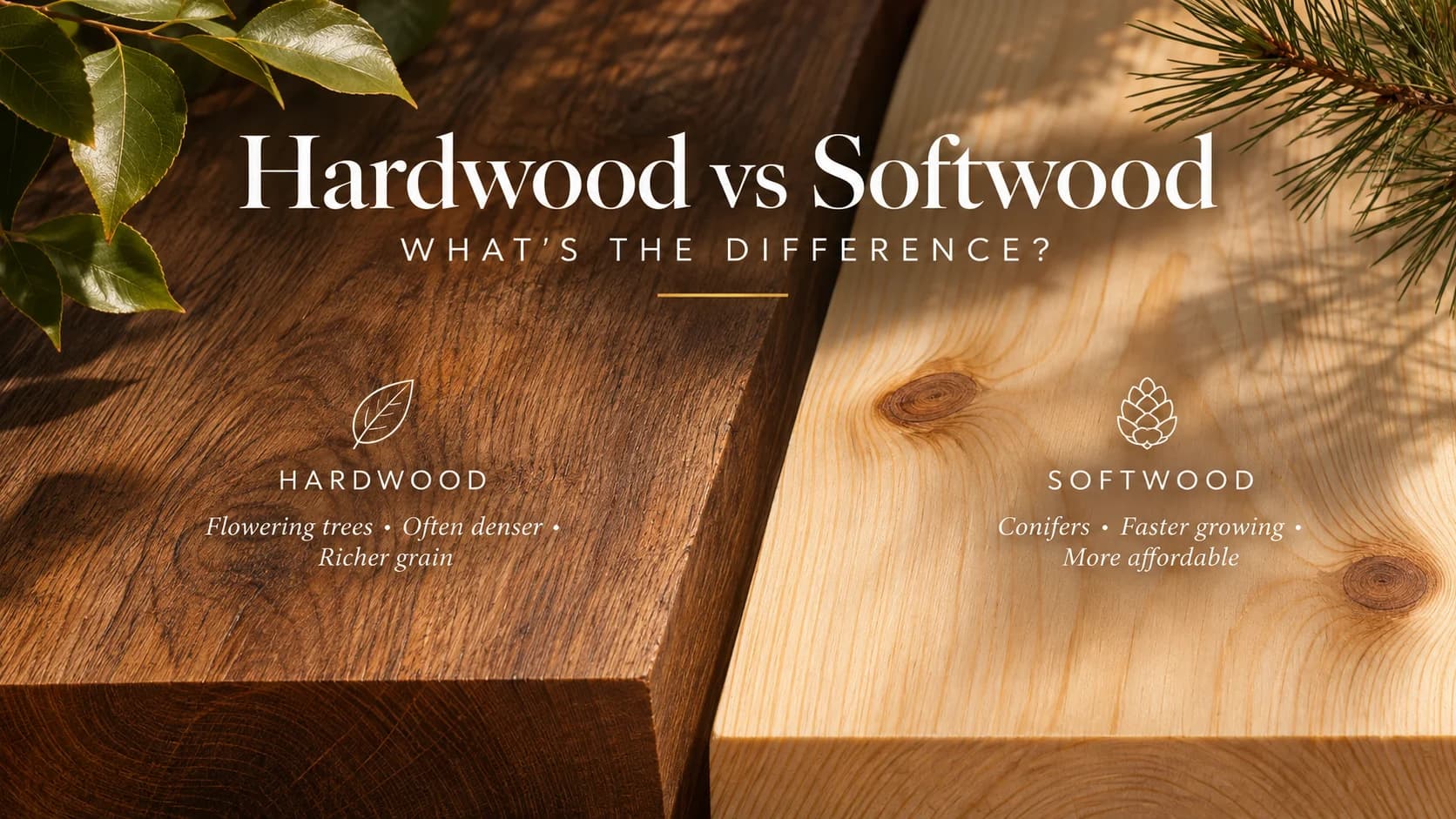
Most people assume 'hardwood' means hard and 'softwood' means soft, which although sounds logical, but it is not how the timber trade uses these words. Even when someone wants to know whether a species is a hardwood, there is a further small distinction between the term hardwood and hard wood. “Hardwood” and “softwood” are categories of tree, while the terms "hard wood" or "soft wood" are used as a physical property, to show how well a piece of timber resists a dent. This guide separates the two, hardwood and softwood, and talks about their difference so the next time you select timber for floors, decks or even furniture, you have the right expectations for each wood.
What is hardwood?
Hardwoods are angiosperm trees, or plants that produce seeds with a covering. They usually form flowers to reproduce. They’re fertilized by birds and insects that carry the pollen to other trees, and when they’re fertilized, the trees form fruits, nuts, or seeds. These types of hardwood trees include walnut, maple, oak, mahogany, teak, and hickory. They don’t include monocots, a type of angiosperm whose seed contains a single embryonic leaf, such as palm trees and bamboo.
In general, hardwood trees are deciduous, which means that they lose their leaves annually. They tend to grow more slowly than softwoods, so they are usually more dense. The difference continues inside the trunk, as hardwood contains pores, also called vessels, and this is the main anatomical difference from softwood, as these pores can range significantly in shape, size, and perforation plates, and these pore-like structures create a wood grain pattern that increases the density of the wood, making “hardwood”, hard.
What is the difference between hardwood and softwood?
Softwood comes from gymnosperms, a word that means “naked seed”. Their seeds are not enclosed in a fruit or nut and usually sit in cones. Softwood trees have needle-like leaves instead of broad ones and include pines, spruces and firs. Inside the wood, softwood is built mostly from tracheids, which is why its structure is simpler than hardwood’s.
Hardwood | Softwood | |
Botanical group | Angiosperm (flowering tree) | Gymnosperm (“naked seed”, mostly conifers) |
Seeds | Enclosed, for example, in a fruit or nut | Not enclosed; usually borne in cones |
Leaves | Broad; most are deciduous. | Needle-like |
Wood structure | Contains pores (vessels); more complex | No pores; mostly tracheids; simpler |
Typical uses | Furniture, flooring, fine woodworking | Framing, fencing, cladding, decking |
Is hardwood always harder?
No, and this is the part that surprises most people. Balsa, one of the softest and least dense woods there is, is botanically a hardwood. Meanwhile, European yew, a softwood, measures about 1,520 lbf on the Janka scale against roughly 70 lbf for balsa. Yew is also harder than basswood, a hardwood that measures about 410 lbf.
The Janka test measures the force needed to push an 11.28 mm steel ball halfway into the wood. A higher number means the wood resists denting better. Penn State Extension publishes values in newtons for several common species:
Hardwood | Hardness (N) | Softwood | Hardness (N) |
|---|---|---|---|
White ash | 5,900 | Loblolly pine | 3,100 |
Northern red oak | 5,700 | Shortleaf pine | 3,100 |
Black cherry | 4,200 | Douglas-fir | 2,900 |
Red maple | 4,200 | Red pine | 2,500 |
Yellow poplar | 2,400 | Eastern hemlock | 2,200 |
Basswood | 1,800 | Balsam fir | 1,800 |
Quaking aspen | 1,600 | Eastern white pine | 1,700 |
Read across the table, and the overlap is clear. Loblolly pine is harder than yellow poplar, basswood and quaking aspen, all of which are hardwoods.
Examples of hardwoods and softwoods
Hardwood examples
The major types of hardwood include oak, ash, maple, walnut, mahogany, teak, hickory, sal and rosewood. IPE, the dense South American timber used for decking, is also a hardwood. And at the soft end, yellow poplar, basswood and balsa are hardwoods too.
Softwood examples
Softwoods include pine, spruce, fir, cedar, Douglas-fir, larch, redwood and cypress. Yew is another softwood that is harder than many hardwoods.
Which is better for flooring, decking and furniture?
Flooring. For floors that take daily wear, dense hardwoods are the usual choice. But always read the species and not just the category, as the yellow poplar is a hardwood, yet at 2,400 N it would dent and scratch on a busy floor. Oak and ash are hence much better choices for flooring applications. Moreover, both are available in our Europa Collection as solid and engineered flooring. Similarly, Natural Pine also suits bedrooms and quieter rooms where its knots and visible character are part of the appeal.
Decking and outdoor use. Softwood is generally less durable outdoors because it takes up moisture and is more open to decay; untreated, it needs another layer of protection. Dense hardwoods such as IPE handle weather naturally, which is why our Brasilia Collection is ideally used for decks and exposed structures. Thermal modification is another route where certain softwood species can be used for these applications, as Norden Therm timbers are heat-treated with no chemicals, which reduces how much moisture the wood absorbs. A softwood like pine, once thermally modified, becomes stable enough for cladding, decking and panelling.
Furniture and interiors. Hardwood is the usual choice for furniture, cabinetry and joinery where strength and a refined grain both matter, and it also takes stain much more evenly. Softwood’s open grain can look blotchy if it is not prepared before finishing, so it suits painted pieces, shelving and panelling.
Ultimately, choosing between hardwood and softwood comes down to the application, the environment and the finish you want to achieve. Understanding the difference helps you look beyond the label and choose timber that balances durability, stability and aesthetics. Whether you’re planning flooring, decking or interiors, the right species makes all the difference.