Engineered Wood Flooring Explained: Layers, Birch Plywood Core & When to Choose It
Understand engineered wood flooring, its layers, birch plywood core, benefits and limitations, and how it compares with solid wood flooring.
What Is Engineered Wood Flooring?
A real wooden floor has a look that you just can’t fake, be it the grain, the natural variations in colour or the warmth underfoot, these are details that make a space feel lived in rather than simply finished. But natural wood is heavily reliant on its surroundings, as changes in temperature and humidity can cause it to expand and contract, changing its shape. For flooring, especially in climates with seasonal humidity fluctuations, this movement needs even more careful preparation. Engineered wood flooring offers a way to enjoy the beauty of real wood with a construction designed for greater dimensional stability.
Unlike solid wood flooring, which is milled from a single piece of timber, engineered wood flooring is made by bonding a real hardwood top layer to a multi-layer core. The core is commonly made from plywood or other engineered materials, with each layer contributing to the board's overall stability. The result is a floor that holds the natural character of timber while offering greater flexibility in plank sizes, installation methods and interior applications. For architects and interior designers, this combination makes engineered wood a practical option for contemporary homes, apartments and carefully designed commercial interiors.
How Is Engineered Wood Flooring Made? Understanding Its Layers
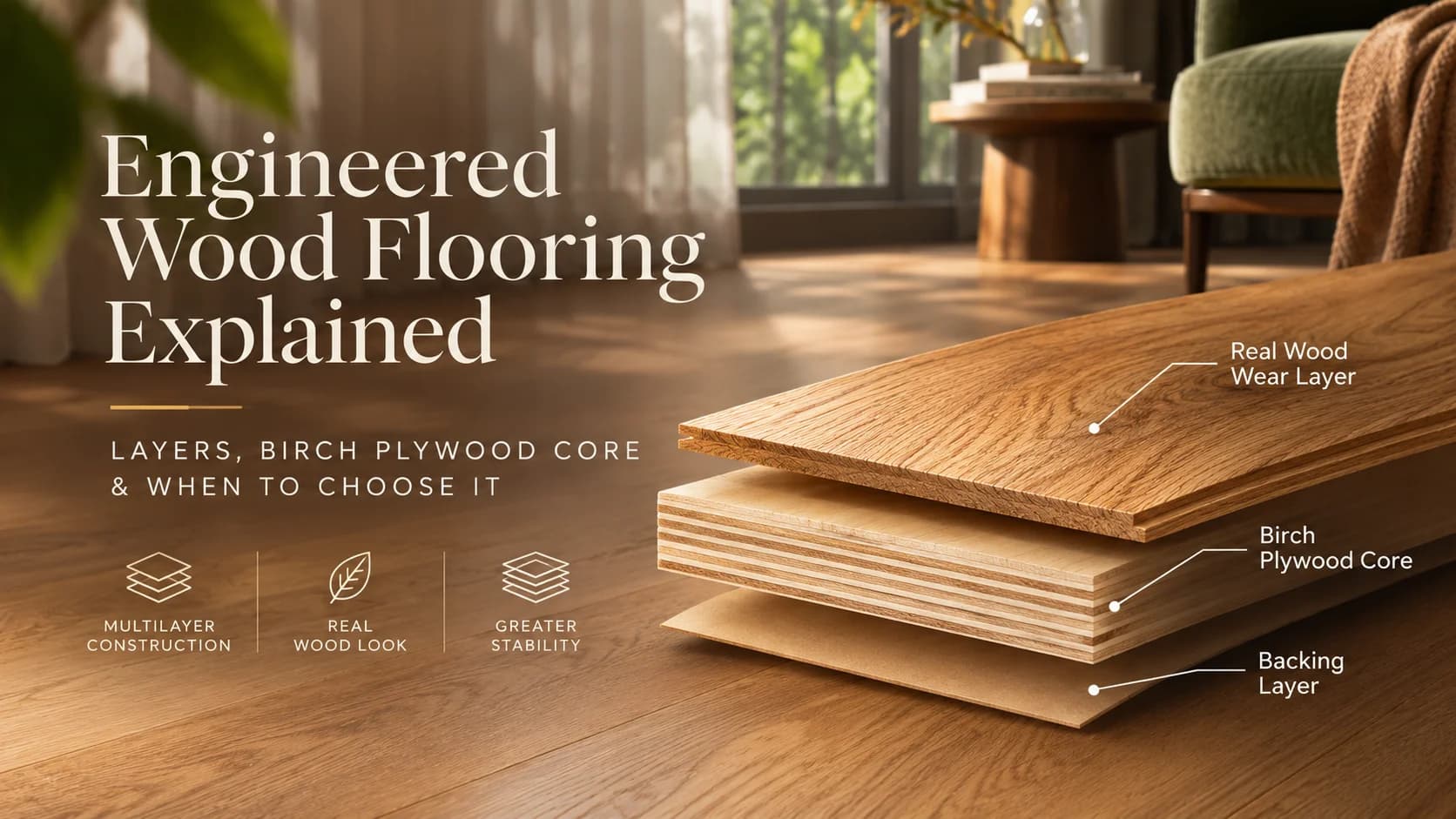
The performance of engineered wood flooring depends on more than the timber species visible on its surface. Its construction, from the top wear layer to the core and backing plays an equally important role. Although the exact composition varies by manufacturer, a typical multilayer wood flooring plank has three main structural components.
1. Real Wood Wear Layer
This is the layer that you interact with every day, made from genuine hardwood; it gives the floor its natural grain and colour as well as texture. Oak is a popular choice for engineered oak flooring because of its distinctive grain and versatility across interior styles. Depending on the product, other timber species may also be available. The thickness of this layer matters as a thicker wear layer may allow sanding and refinishing in the future, while a thinner one may be suitable only for surface maintenance or limited restoration.
2. Structural Core
The core sits beneath the hardwood surface and provides much of the board's structural support. In engineered flooring with birch plywood, the core consists of multiple thin wood veneers bonded together, typically with adjacent layers arranged so their grain directions cross. This construction helps counteract the natural expansion and contraction of wood across the grain.
Birch plywood is valued in flooring applications for its uniform construction and strength. However, the quality of the plywood, adhesive bonding, layer arrangement and manufacturing process all influence the final product's performance. This is why the core deserves as much attention as the visible wood species when selecting engineered flooring.
3. Backing Layer
The backing forms the underside of the plank. It helps balance the construction and contributes to the board's dimensional stability. Working together, the backing, core and hardwood wear layer form a multilayer structure designed to minimise unwanted movement.
Understanding the Construction at a Glance
Typical engineered wood flooring structure from top to bottom
Layer | Primary function |
Protective surface finish | Helps protect against everyday wear, marks and stains |
Real hardwood wear layer | Provides the natural appearance, grain and texture |
Birch plywood or other structural core | Provides support and helps improve dimensional stability |
Backing layer | Helps balance the board's construction |
Why Choose Engineered Flooring with a Birch Plywood Core?
Not all engineered wood flooring is built the same way. The core material can influence stability, strength and suitability for different interior environments. Birch plywood core flooring is one option worth considering when comparing multilayer wood flooring. Here is why:
Greater dimensional stability: Cross-layered plywood helps reduce the movement associated with changes in humidity. This can make engineered flooring more predictable than solid wood, although it does not eliminate movement entirely.
A strong structural foundation: Quality plywood provides a stable base for the hardwood wear layer. The final performance still depends on the plywood grade, bonding quality and overall board construction.
Support for contemporary plank formats: Engineered construction can accommodate wider planks and varied flooring designs. This gives designers more freedom when creating spacious, continuous-looking floors.
The appearance of real timber: A birch plywood core does not mean the visible surface is birch. The top layer can feature another wood species, such as oak, allowing the floor to retain the appearance and character of the selected hardwood.
For buyers comparing engineered flooring with birch plywood against alternatives, it is worth checking the core's actual composition rather than relying on the product name alone.
Engineered vs Solid Wood Flooring: Which Is Better?
Both options offer the natural beauty of timber, but their construction makes them suitable for different requirements. Solid wood flooring is made from a single piece of timber, while engineered flooring combines a hardwood surface with a layered core. Neither is universally better; the right choice depends on the installation environment, maintenance expectations and desired lifespan.
Feature | Engineered wood flooring | Solid wood flooring |
Construction | Real hardwood surface over a multilayer core | One piece of solid timber |
Dimensional stability | Generally more stable during humidity fluctuations | More susceptible to expansion and contraction |
Design flexibility | Well suited to a range of plank formats, including wider boards | Wide boards require careful consideration of wood movement. |
Installation | May be floated, glued or mechanically fixed, depending on the product | Commonly nailed or fixed over a suitable subfloor |
Sanding and refinishing | Depends on the thickness of the hardwood wear layer | Usually allows more refinishing over its lifetime |
Moisture management | Requires moisture control and is not waterproof | Also requires moisture control and is not waterproof |
Best suited for | Projects prioritising stability and installation flexibility | Projects prioritising solid timber construction and long-term refinishing potential |
If long-term refinishing is your priority and the installation environment is suitable, solid wood may be the better fit, however if you want the appearance of natural timber with greater dimensional stability and flexibility in installation, engineered wood flooring deserves serious consideration.
When Should You Choose Engineered Wood Flooring?
The best flooring decision begins with understanding how a space will be used. Engineered wood can be particularly suitable for the following applications.
Contemporary Homes and Apartments: In modern homes, wide planks and continuous flooring can create a sense of visual calm. Engineered flooring offers flexibility in plank formats while retaining the warmth and variation of genuine wood.
Interiors with Changing Humidity Conditions: Where indoor humidity fluctuates seasonally, engineered construction can help reduce dimensional movement compared with solid wood. However, this does not make engineered flooring immune to moisture. In Indian homes, particularly in humid regions, proper acclimatisation, subfloor moisture testing, suitable installation and indoor humidity management remain essential.
Renovation Projects: Some engineered flooring systems can be installed over approved existing subfloors, depending on their condition and the manufacturer's requirements. This can offer flexibility during renovation, but the existing surface must still be assessed for levelness, moisture and structural suitability.
Interiors with a Preference for Natural Materials: For living rooms, bedrooms, studies and other interior spaces, engineered oak flooring can bring the character of natural grain into a design without requiring every plank to be made from solid oak throughout its thickness. The finish, grade and plank dimensions can then be selected to complement the overall interior scheme.
Can Engineered Wood Flooring Be Sanded and Refinished?
Yes, some engineered wood floors can be sanded and refinished, but it depends on the thickness of the real wood wear layer and the manufacturer's recommendations. The hardwood surface is the only part that can be sanded, as the plywood core beneath it cannot be treated as additional sanding material. A thicker wear layer generally provides more scope for future refinishing, while a thinner layer may not safely support conventional sanding. Previous sanding, surface texture and the condition of the installed boards also affect what is possible. Before purchasing, ask for the wear-layer thickness, the recommended refinishing method and the manufacturer's guidance on how many times the floor may be refinished, if at all. Regular maintenance is equally important, always use a soft broom or vacuum suitable for wood floors, clean spills promptly and avoid excessive water during cleaning.
Frequently Asked Questions
What is engineered wood flooring?
Engineered wood flooring is a multilayer flooring product made with a real hardwood surface bonded to a structural core, commonly plywood or another engineered material. Its layered construction is designed to provide greater dimensional stability than a solid wood plank.
What is engineered flooring with birch plywood?
Engineered flooring with birch plywood uses birch plywood as its structural core beneath a real wood wear layer. The cross-layered construction helps reduce movement caused by changes in temperature and humidity. The visible wood species may be oak or another timber rather than birch.
Is engineered wood flooring better than solid wood flooring?
Neither is automatically better. Engineered flooring generally offers more dimensional stability and installation flexibility. Solid wood usually gives you more chances to refinish over its life. When you weigh engineered vs solid wood flooring, look at your subfloor, the conditions in the room, your design needs and how much upkeep you'll do.
Is engineered oak flooring real wood?
Yes, engineered oak flooring features a genuine oak surface layer bonded to a structural core. It offers the natural grain and character of oak without requiring the entire plank to be solid oak.
Can engineered wood flooring be sanded and refinished?
Some products can be sanded and refinished, depending on their hardwood wear-layer thickness, remaining usable material and manufacturer specifications. Check the details before buying, particularly if you want the option to restore the floor in the future.